
Renting a property comes with certain expectations, one of which is that the landlord will maintain the property and ensure it’s safe and habitable.
However, there are times when landlords neglect their responsibilities, leaving tenants to deal with unresolved maintenance issues. Whether it’s a leaky roof, a broken heater in the middle of winter, or a pest infestation, living in a poorly maintained rental can be extremely frustrating and even dangerous.
Table of Contents
- Understand Your Rights as a Tenant
- Deep Dive Podcast
- Related Questions
If you find yourself in a situation where your landlord isn’t making necessary repairs, there are steps you can take to resolve the issue. This blog post will provide practical advice on how to handle such situations, as well as legal guidance to protect your rights as a tenant.

Understand Your Rights as a Tenant
Before diving into what actions you can take, it’s important to understand your rights as a tenant. In most places, landlords are legally obligated to maintain their properties and ensure they are safe, habitable, and meet local housing codes. This includes:
- Providing a safe living environment – The property must be free from hazards like mold, pests, and structural issues.
- Maintaining essential services – This includes ensuring access to heat, water, electricity, and plumbing.
- Addressing repairs in a timely manner – Landlords are responsible for fixing issues that affect the habitability of the property, such as broken heating systems, leaky roofs, or faulty plumbing.
The specific laws governing landlord responsibilities vary by state, province, or country, so it’s critical to familiarize yourself with your local tenant laws. You can usually find this information on government housing websites or through local tenant advocacy organizations.
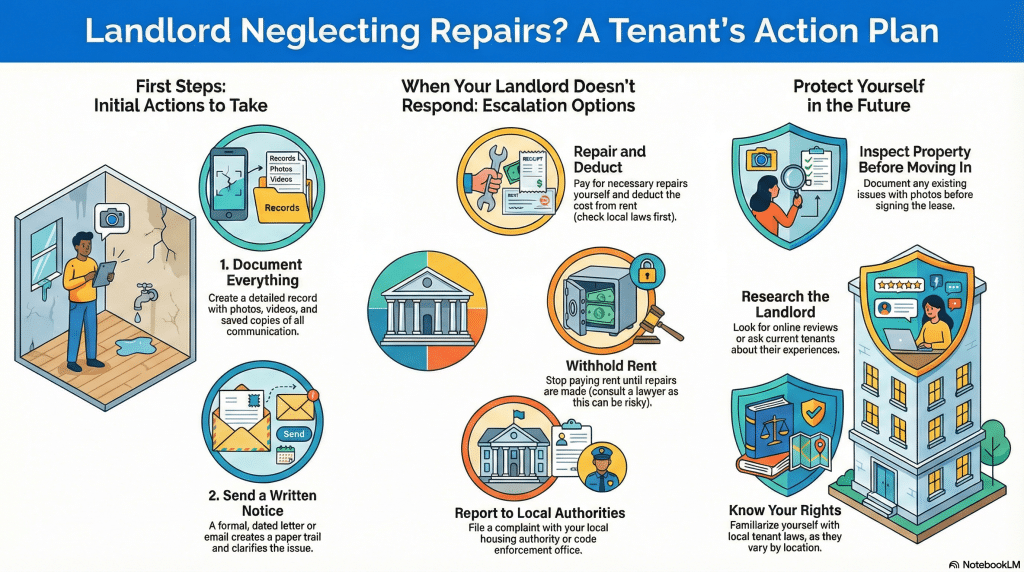
Step 1: Document the Problem
The first step in addressing any repair issue is to document it thoroughly. This will provide evidence if you need to take legal action or file a complaint later. Here’s how to do it:
- Take photos or videos of the issue, making sure to capture the extent of the damage or problem. For example, if there’s a leak, record the water dripping or pooling.
- Keep records of communication with your landlord. Save emails, texts, and written letters that detail your requests for repairs.
- Document the impact on your living conditions. For instance, if your heating is broken during the winter, note the temperature inside your home.
Having clear documentation will strengthen your case if you need to escalate the situation.

Step 2: Notify Your Landlord in Writing
Once you’ve documented the issue, notify your landlord about the needed repairs. While you may have already mentioned the problem verbally, it’s crucial to follow up in writing. A written request creates a paper trail and ensures there is no confusion about the issue or timeline.
What to include in your written request:
- A clear description of the issue – Be specific about what needs to be repaired and where the problem is located.
- A timeline of events – Include when the issue started and any previous attempts to resolve it.
- A request for action – Politely but firmly ask your landlord to address the issue within a reasonable timeframe.
- Your contact information – Provide your phone number or email so they can reach you to discuss the repair.
Example Of A Repair Request
Here’s an example of how to write a repair request:
Subject: Request for Repairs
Dear [Landlord’s Name],
I am writing to inform you about an issue in my rental unit at [your address] that requires immediate attention. [Describe the problem, e.g., “The heating system is not working, and the temperature inside the unit is dropping below 60°F.”]
This issue began on [date], and I initially reported it to you on [date]. However, the problem has not yet been resolved, and it is significantly affecting my living conditions.
I kindly request that you address this issue as soon as possible. Please let me know when I can expect the repairs to be completed. You can reach me at [your phone number/email] to discuss the next steps.
Thank you for your attention to this matter.
Sincerely,
[Your Name]
Follow up if necessary:
If your landlord doesn’t respond within a reasonable timeframe (e.g., 7-10 days), follow up with another written request. Be sure to reference your initial communication and reiterate the urgency of the problem.
Step 3: Understand Your Legal Options
If your landlord still doesn’t take action, you may need to explore your legal options. Here are some common legal remedies available to tenants:
1. Repair and Deduct
In many states or regions, tenants are allowed to pay for necessary repairs themselves and deduct the cost from their rent. However, this typically requires you to follow specific steps, such as:
- Providing written notice to your landlord about the issue.
- Giving your landlord a reasonable amount of time to make the repair.
- Obtaining quotes or estimates from licensed professionals before proceeding with the repair.
- Keeping all receipts and documentation of the repair work.
Make sure to check your local tenant laws to see if this option is available to you and what the specific requirements are.
2. Withhold Rent
In some jurisdictions, tenants are allowed to withhold rent until the landlord makes the necessary repairs. However, this can be a risky strategy because it may lead to eviction proceedings. If you plan to withhold rent, consult a tenant lawyer or local housing authority first to ensure you’re following the correct legal process.
3. Report the Landlord to Local Authorities
If your landlord is refusing to make repairs that affect the safety or habitability of the property, you may be able to file a complaint with your local housing authority or code enforcement office. They can inspect the property and, if necessary, issue a citation or fine to the landlord for violating housing codes.
4. Terminate the Lease
If the issue is severe and your landlord refuses to address it, you may have the right to terminate your lease without penalty. This is usually only allowed in cases where the property is deemed uninhabitable. Again, consult local tenant laws or a lawyer to ensure you’re following the proper procedures.
5. File a Lawsuit
As a last resort, you may be able to file a lawsuit against your landlord for failing to make necessary repairs. This could involve suing for damages, such as the cost of repairs you paid for yourself, or compensation for any harm caused by the landlord’s negligence (e.g., medical bills due to unsafe living conditions).

Step 4: Explore Practical Solutions
While pursuing legal action may be necessary in some cases, it’s often best to try practical solutions first. Here are some additional steps you can take:
1. Communicate Clearly and Professionally
Sometimes, landlords fail to make repairs because they don’t understand the severity of the issue or are overwhelmed with other responsibilities. Make sure your communication is clear, professional, and solution-focused. Avoid being confrontational, as this can escalate the situation unnecessarily.
2. Offer to Help Facilitate Repairs
If your landlord is struggling to find a contractor or schedule repairs, offer to help. For example, you could provide a list of local repair services or be available to let workers into the property. While it’s not your responsibility to manage repairs, offering assistance can sometimes expedite the process.
3. Connect with Other Tenants
If you live in a multi-unit property, talk to your neighbors to see if they’re experiencing similar issues. If multiple tenants are affected, you may be able to present a united front to the landlord. This can be more effective than addressing the issue alone.
4. Use Mediation Services
If communication with your landlord has broken down, consider using a mediation service. Many communities offer free or low-cost mediation programs to help landlords and tenants resolve disputes without going to court.
Step 5: Protect Yourself in the Future
If you’ve had a bad experience with a landlord who refuses to make repairs, take steps to protect yourself in future rental situations:
1. Inspect the Property Before Moving In
Before signing a lease, thoroughly inspect the property for any existing issues. Make a list of any problems you notice and ask the landlord to address them before you move in. Take photos or videos of the property’s condition to document any pre-existing damage.
2. Read the Lease Carefully
Pay close attention to the maintenance and repair clauses in your lease. Make sure the lease clearly outlines the landlord’s responsibilities for repairs and maintenance, as well as the process for reporting issues.
3. Research the Landlord
Before renting a property, research the landlord or property management company. Look for online reviews or ask current tenants about their experiences. This can give you a sense of whether the landlord is responsive to maintenance requests.
4. Know Your Rights
Familiarize yourself with local tenant laws and regulations. Knowing your rights as a tenant will help you advocate for yourself and take appropriate action if your landlord fails to meet their obligations.
Dealing with a landlord who refuses to make necessary repairs can be frustrating and stressful, but you’re not powerless. By documenting the issue, communicating effectively, and understanding your legal rights, you can take steps to resolve the problem and protect yourself from further issues. Whether it’s pursuing practical solutions, filing a complaint, or taking legal action, there are options available to ensure your landlord fulfills their obligations.
Remember, the key to successfully navigating these situations is to remain calm, professional, and informed. By following the steps outlined in this guide, you can address repair issues effectively and ensure your rental property remains a safe and comfortable place to call home.
Deep Dive Podcast
Listen to our Deep Dive Podcast.
Real Estate Crunch gives you real property and real estate information and advice. We offer a free monthly newsletter; you can sign up for our newsletter by clicking here.
We also have a weekly podcast called “Real Estate Crunch,” found on all major podcast platforms. Listen to our podcast by clicking here. And check out and subscribe to our YouTube Channel – Real Estate Crunch.
Follow us on our social media platforms – Facebook and Instagram.
Related Questions
What Is A Life Estate? Real Estate Explained
A life estate is when a person is granted the right to use the property for the term of their life. Once the life estate holder dies, then the property is passed on to the property owner. The individual who holds the life estate does have rights to the property and can usually still get income from the property for the term of their life.
By clicking here, you can read more about What Is A Life Estate? Real Estate Explained
The Legal Description Of Property Importance In Real Estate
The legal description of the land or property is a written record that will show precisely what land it is yours. It is a legal document that can be used if a legal dispute over land arises. There are three basic methods by which boundaries are shown for lands Rectangular Survey System, Metes and Bounds, and Blocks and Lots.
By clicking here, you can read more about The Legal Description Of Property Importance In Real Estate