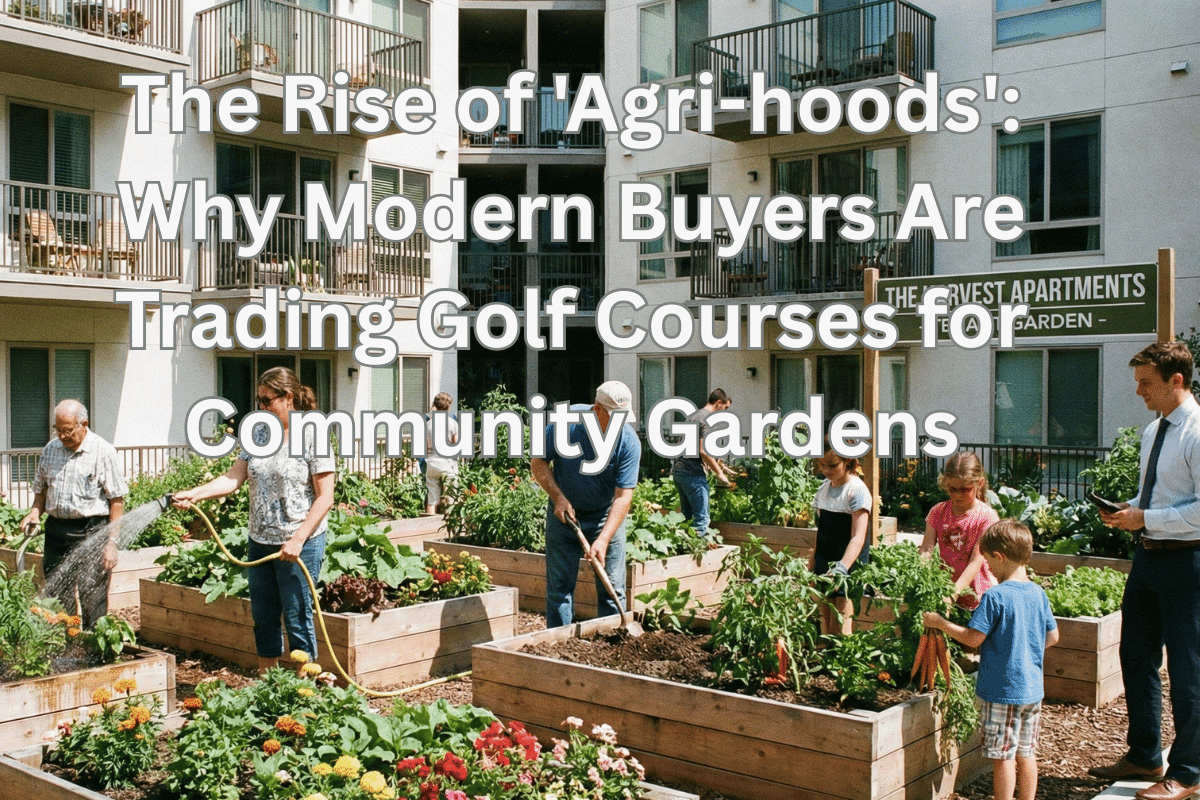
Lately, I’ve been on a bit of a mission. If you follow my updates, you know I’ve been scouring the real estate market in Salt Lake City and Utah County. I’m looking for an apartment—but not just any apartment. My checklist doesn’t prioritize a rooftop infinity pool or a high-tech “smart” fridge. At the very top of my list is a seemingly simple requirement: access to a community garden.
Having spent most of my life navigating the neon-lit, high-density jungles of Hong Kong, Bangkok, and Hanoi, I’m certainly no stranger to city living. I love the energy of a metropolis. But those years in Vietnam and Thailand taught me something vital: the most luxurious amenity a developer can offer isn’t stainless steel; it’s the ability to get your hands dirty in the soil.
Table of Contents
- The “Agriz-hood” vs. The Golf Course: A New Era of Luxury
- Generational Attitudes: Who’s Leading the Green Revolution?
- Deep Dive Podcast
- Related Questions
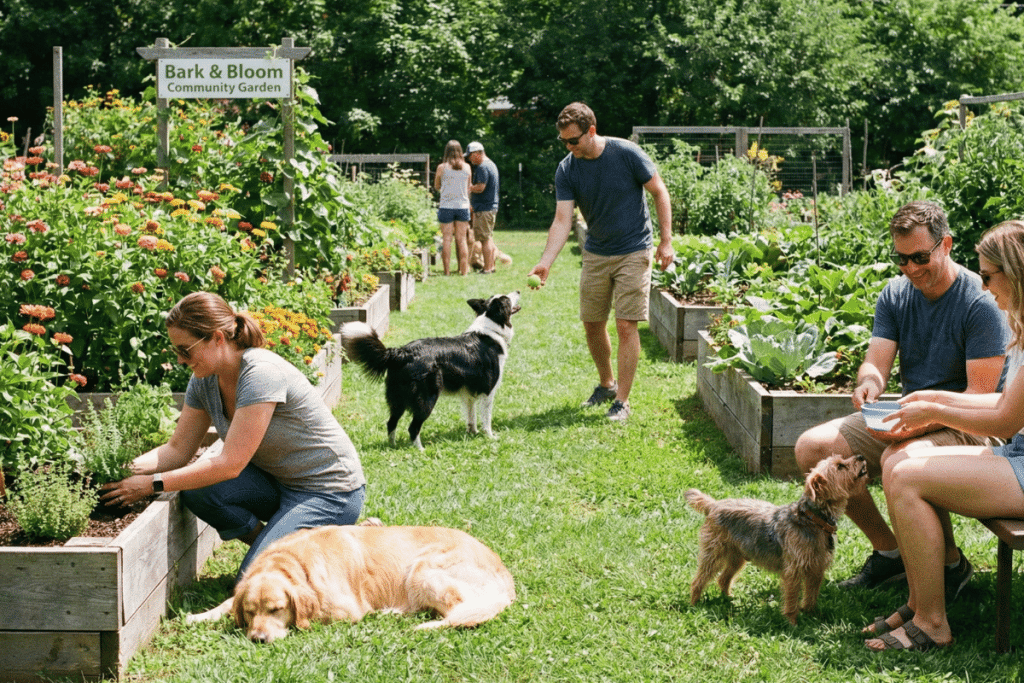
When an apartment complex says, “Let’s have a green space where tenants can grow their own food,” they aren’t just planting seeds; they’re planting a community. This is the heart of the “Agri-hood” movement, a trend that is rapidly seeing modern buyers and renters trade the manicured fairways of a golf course for the fertile rows of a community garden.
The “Agriz-hood” vs. The Golf Course: A New Era of Luxury
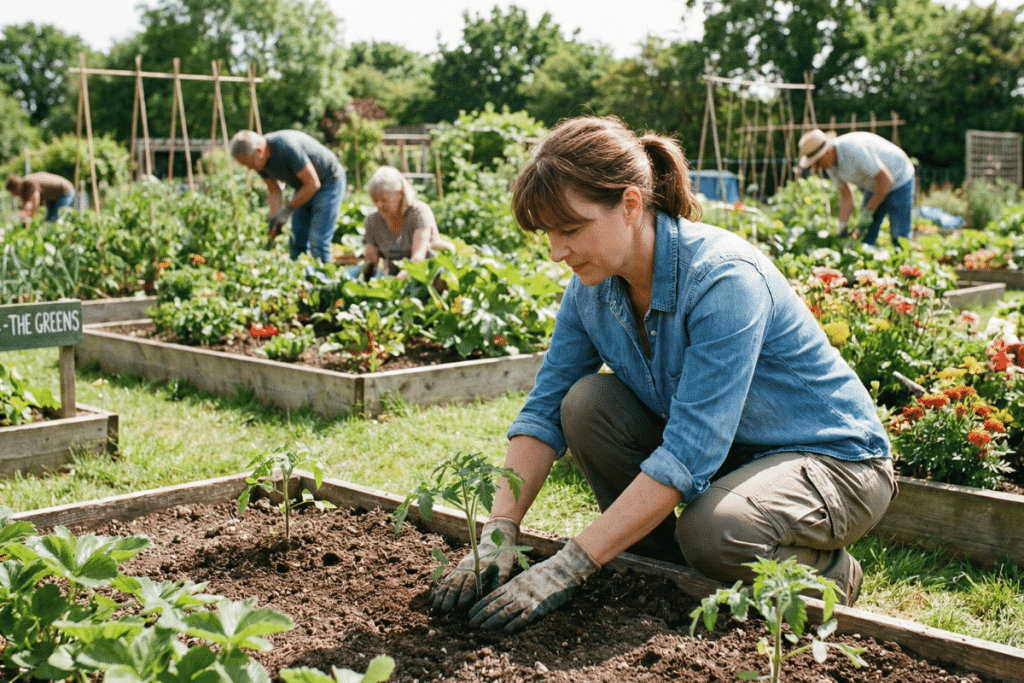
For decades, the pinnacle of suburban “luxury” was the golf course community. You lived on the 9th hole, paid high HOA fees for the grass to be cut just right, and enjoyed the view of the fairway. But times are changing. The modern resident—whether in a bustling urban hub like Salt Lake City or a growing suburb in Utah County—is looking for something more functional, sustainable, and soulful.
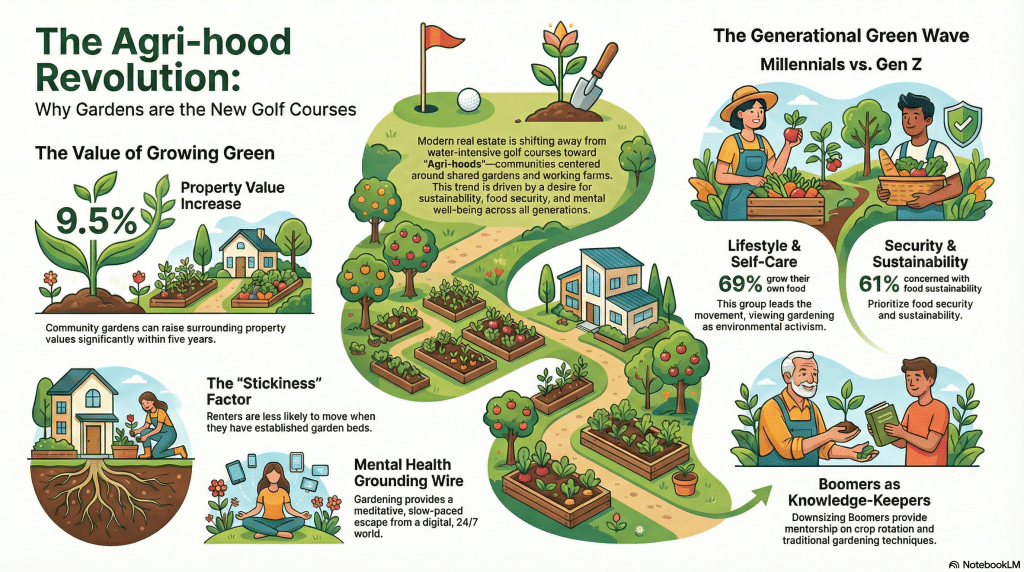
Enter the Agri-hood. Instead of a clubhouse and 18 holes of water-intensive grass, these neighborhoods are centered around a working farm, an orchard, or a shared tenant garden. It turns out that a basket of fresh kale and a chat with a neighbor over a tomato plant is worth more to today’s market than a low handicap.
Why Growing Your Own Food is “Magical”
I’ve realized that the appeal of the community garden isn’t just about the produce (though a sun-ripened tomato beats a grocery store one every time). It’s about four key pillars:
The Harvest:
Let’s be honest—inflation is real. Having a supplement of fresh herbs, leafy greens, and seasonal vegetables right outside your door is a massive win for your kitchen and your wallet.
The Magic of Growth:
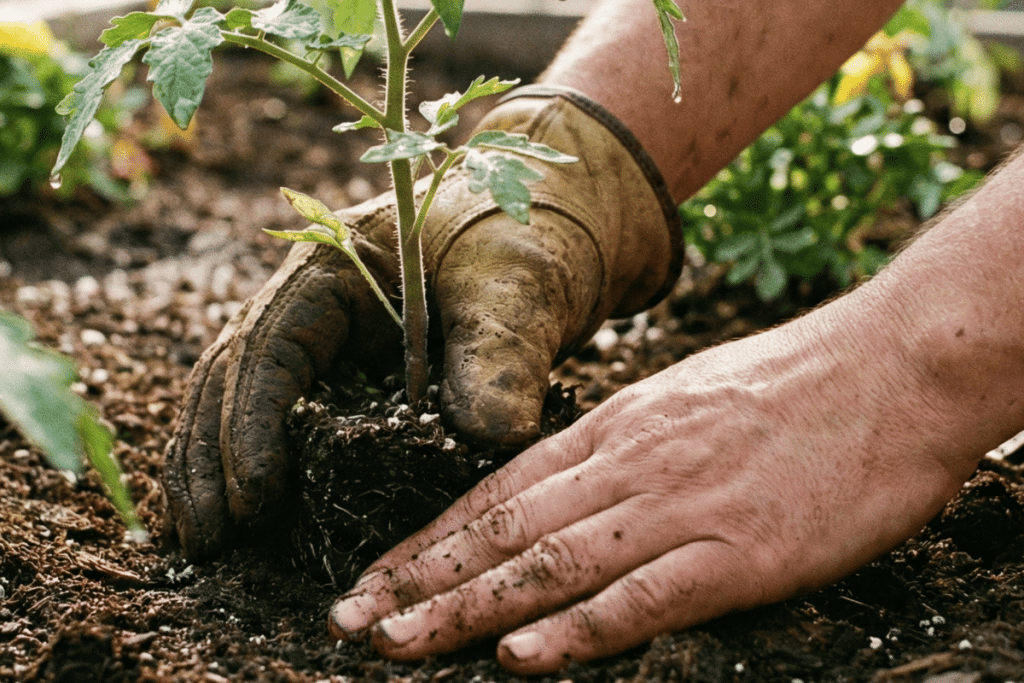
There is something truly meditative—dare I say magical—about watching a seed you planted break through the soil and turn into a meal. In our digital, 24/7 world, this slow, natural process is a necessary grounding wire for our mental health.
The “Get Your Hands Dirty” Community:
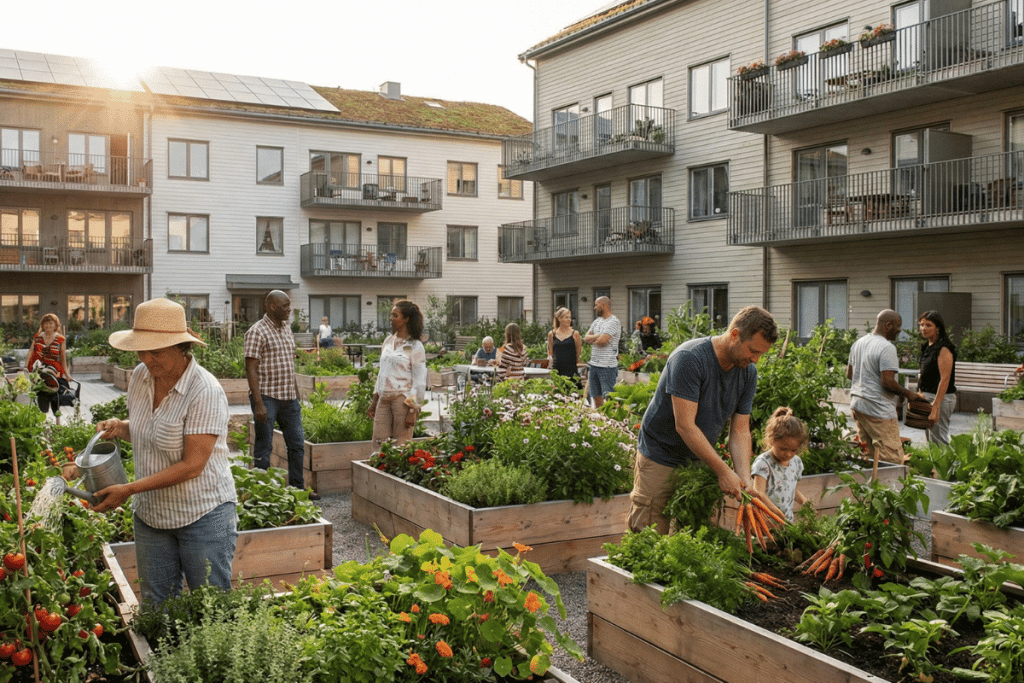
Urban living can be lonely. But when you’re working side-by-side in a garden, the barriers come down. You get to know your neighbors as people, not just “the guy in 4B.” You share tips, you swap surplus zucchinis, and you build a real neighborhood.
The “Sell” Factor:
From a real estate perspective, green spaces are gold. Data shows that community gardens can raise surrounding property values by up to 9.5% within five years. For renters, it’s a high-value amenity that creates “stickiness”—you’re much less likely to move out if you have a garden bed you’ve spent months tending.
Generational Attitudes: Who’s Leading the Green Revolution?
The interest in “Agri-hoods” isn’t a monolith; different generations are coming to the garden for different reasons.
Millennials: The Urban Growing Pioneers
Millennials (born ~1981-1996) are the undisputed leaders of this movement. Research shows that 69% of Millennials are now growing their own food. For this group, gardening is a form of environmental activism and self-care.
Often called “plant parents,” they’ve moved beyond indoor succulents and are now demanding outdoor space. Because they are 29% more likely to garden for food production than previous generations, they are specifically looking for apartments in SLC and beyond that offer container gardening or shared plots.
For them, a community garden isn’t a perk; it’s a lifestyle requirement.
Gen Z: Food Security and Sustainability
For Gen Z (born ~1997-2012), the motivation is often more urgent. About 61% of Gen Zers express deep concern about food sustainability. Having grown up in an era of climate anxiety and rising food costs, they view the ability to grow their own food as a step toward self-sufficiency and food security.
They are also the generation most likely to integrate technology into the soil, using TikTok and Instagram to learn about hydroponics and vertical farming. If an apartment in Utah County offers a high-tech “indoor garden” or a vertical herb wall, they’ve already won over the Gen Z renter.
Baby Boomers: The Traditional Knowledge-Keepers
Baby Boomers (born ~1946-1964) bring the experience. Many Boomers grew up with traditional gardens or learned from parents who lived through times of scarcity. For them, the shift toward Agri-hoods is a “return to form.”
As they downsize from large family homes into luxury apartments or condos, they don’t want to lose their connection to the earth. They often serve as the “mentors” in community gardens, passing down knowledge about crop rotation and canning to the younger generations.
Gen X: The Bridge Generation
Gen X (born ~1965-1980) balances the two worlds. They garden to provide healthy, organic food for their families and to teach their children where food actually comes from (spoiler: it’s not the plastic wrap at the store). They are the “practical” gardeners, looking for efficiency and sustainability in equal measure.
The Salt Lake City and Utah County Outlook
As I look at the market here in Utah, I’m seeing some incredible examples of this trend. New developments in Sugar House or the Silicon Slopes are starting to realize that “green space” needs to be more than just a manicured lawn you can’t walk on. As are some apartments in the Provo area.
Some of the apartments on the top of my list have set aside literal “tenant garden” zones. This is a game-changer. It means you can live in a modern, urban environment but still have that “farmhouse” connection to the land.
Final Thoughts
Whether you are a developer looking to increase your ROI or a renter (like me) looking for a place to call home, the message is clear: The future of real estate is green. We are trading the exclusivity of the golf course for the inclusivity of the garden.
There is a profound joy in getting your hands dirty, spending time outside, and building a community one seed at a time. If you’re looking for a new place, I highly recommend checking out the “Agri-hood” options in your area. Your kitchen—and your soul—will thank you.
Deep Dive Podcast
Check out our Deep Dive Podcast.
Real Estate Crunch gives you real property and real estate information and advice. We offer a free monthly newsletter; you can sign up for our newsletter by clicking here.
Subscribe to our Youtube Channel – Real Estate Crunch – by clicking here.
We also have a weekly podcast called “Real Estate Crunch,” found on all major podcast platforms. Listen to our podcast by clicking here.
Follow us on our social media platforms – Facebook and Instagram.
Related Questions
Should You Hire a Real Estate Agent or Buy/Sell on Your Own?
Buying or selling a home is one of the most significant financial transactions people will ever make.
With such high stakes, it’s natural to wonder whether you should hire a real estate agent or handle the process independently. While some buyers and sellers successfully go the DIY route, others find that hiring an agent makes the process smoother and more efficient. Read on as we will explore the pros and cons of using a real estate agent versus a DIY approach, helping you determine which option is best for your situation.
By clicking here, you can read more about Should You Hire a Real Estate Agent or Buy/Sell on Your Own?
Top 15 Mistakes Home Sellers Make and How to Avoid Them
Selling a home can be a complex and emotional process. For most people, selling their home is one of their most significant and complex undertakings.
While the ultimate goal of most home sellers is to sell quickly and at a reasonable price, inevitable mistakes can lead to delays, reduced offers, or even a failed sale. Read on as we will highlight the top 15 mistakes home sellers make and provide actionable advice on how to avoid them.
By clicking here, you can read more about Top 15 Mistakes Home Sellers Make and How to Avoid Them.
How to Stage Your Home to Sell Faster and for a Higher Price
Selling a home can be both an exciting and challenging process. Home staging is one of the most effective strategies to ensure a quick sale and maximize your property’s value.
By thoughtfully preparing your home to appeal to the broadest range of buyers, you can create a memorable first impression that attracts attention and encourages higher offers. In this blog post, we’ll explore what home staging is and why it’s essential and offer actionable tips for staging every key area of your home to help you achieve a successful sale.
By clicking here, you can read more about How to Stage Your Home to Sell Faster and for a Higher Price.

Leave a Reply
You must be logged in to post a comment.