In the current real estate crunch, hiring the wrong agent is an expensive mistake. Here is your essential guide to interviewing real estate agents, uncovering agent commission secrets, and getting the honest home buyer tips you deserve.
The real estate market has changed. We are living through “the crunch”—a period defined by volatile interest rates, stubborn inventory shortages, and an economic landscape that shifts beneath our feet daily.
Table of Contents
- 10 Essential Questions Most Realtors Hope You’ll Forget to Ask
- 1. “Are your fees negotiable, and can you break down exactly what I get for that percentage?”
- 2. “What is your list-to-sale price ratio over the last six months in this specific zip code?”
- 3. “How many active clients are you currently representing right now?”
- 4. “Do you practice Dual Agency on your own listings, and if so, how do you manage the conflict of interest?”
- 5. “Who will I be communicating with most: you, or your assistant/team member?”
- 6. “Can you tell me about the last deal you had that almost fell apart, and exactly what you did to save it?”
- 7. “Besides comparable sales (comps), what specific economic factors are you using to price my home right now?”
- 8. (As a Buyer): “What are the three biggest downsides to this property that I might be overlooking?”
- 9. “If I am unhappy with your service, will you allow me to cancel our listing or buyer agreement immediately, in writing, with no penalty?”
- 10. “Do you receive any financial incentives, kickbacks, or ‘co-marketing fees’ from the lenders, inspectors, or title companies you recommend?”
- Deep Dive Podcast
- Related Questions
10 Essential Questions Most Realtors Hope You’ll Forget to Ask
In this environment, your choice of representation isn’t just a minor detail; it’s the difference between securing your financial future and making a mistake that could haunt you for a decade.
Yet, most buyers and sellers treat hiring an agent with the same level of scrutiny as ordering a latte. Statistics show that the vast majority of people hire the first real estate agent they interview. They rely on a cousin’s recommendation or a friendly face on a bus stop bench advertisement.
This is madness.
A real estate transaction is likely the largest financial move of your life. You aren’t hiring a friend; you are hiring a high-stakes negotiator, a market analyst, and a legal contract expert.
When you are interviewing real estate agents, the standard questions—”How long have you been in the business?” or ” Do you know this neighborhood?”—are practically useless. Any halfway decent agent has canned, polished answers for those.
To truly understand who you are hiring, you need to make them uncomfortable. You need to ask the questions that cut through the sales script and reveal how they operate when the pressure is on.
Below are the 10 questions average real estate agents pray you won’t ask—and why the truly great agents will be thrilled to answer them.

1. “Are your fees negotiable, and can you break down exactly what I get for that percentage?”
The Squirm Factor: This is the ultimate taboo topic. Agent commission secrets are guarded fiercely in the industry. Many agents are trained to recite scripts designed to deflect commission questions, often implying that commissions are “standard” (they aren’t, and suggesting so is an antitrust violation) or that cutting commissions means cutting service. They don’t want you to devalue their time, and they certainly don’t want to get into a bidding war with a discount brokerage.
The Crunch Answer: You need to ask this not necessarily to get the cheapest rate, but to understand value. In the current market crunch, houses don’t just sell themselves anymore.
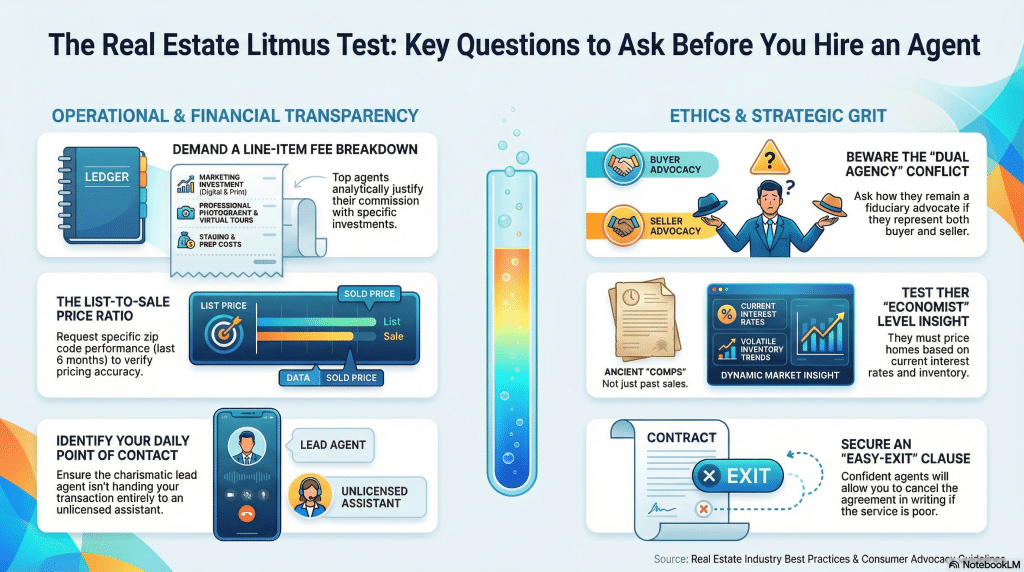
A top-tier agent will look you in the eye and explain exactly why they charge what they charge. They won’t get defensive; they will get analytical. They should provide a line-item breakdown of their marketing spend: professional photography, 3D tours, paid social media advertising, staging consultations, and broker open houses.
If their only answer is, “I put it on the MLS and handle the paperwork,” their fee should reflect that minimum effort. If they cannot articulate their value proposition beyond generic platitudes, keep looking.
2. “What is your list-to-sale price ratio over the last six months in this specific zip code?”
The Squirm Factor: Agents love to tout their total sales volume (“I sold $20 million last year!”). But volume just means they are busy; it doesn’t mean they are effective for you.
Asking for their list-to-sale ratio forces them to reveal how accurate their pricing strategy is. If they list homes for $500k and they eventually sell for $450k, their ratio is poor. They don’t want you to know that they habitually overpromise to get the listing, only to beat the seller down on price later.
The Crunch Answer: You need hard data, not anecdotes. By narrowing it down to the last six months and a specific zip code, you remove their ability to hide behind data from the “unicorn years” of 2021-2022 or use irrelevant stats from a different town.
A great agent will know this number off the top of their head. They will say, “In 30305, my listings have sold for an average of 98.5% of the asking price over the last six months, whereas the market average is only 94%.” That is the kind of statistical competence you are looking for.

3. “How many active clients are you currently representing right now?”
The Squirm Factor: This is a trap question. If the number is too low, you wonder if they are successful. If the number is too high, you wonder if you’ll ever be able to get them on the phone. Agents want to appear busy enough to be in demand, but available enough to service you. They hate having to quantify this balancing act.
The Crunch Answer: There is no magic number, but their answer reveals their operational capacity. A solo agent claiming to handle 30 active buyers and 20 active listings simultaneously is either lying, completely burned out, or dropping the ball constantly.
You want to hear something like: “I currently have five active listings and am working with four serious buyer clients. I cap my client load at 12 to ensure everyone gets daily attention. If I exceed that, I bring in my licensed partner to assist.” You are looking for self-awareness regarding workload management.
4. “Do you practice Dual Agency on your own listings, and if so, how do you manage the conflict of interest?”
The Squirm Factor: Dual agency occurs when one agent represents both the buyer and the seller in the same transaction. In many states, it’s legal (though often highly regulated); in some, it’s banned.
Why do agents love it? They get “the whole hog”—double the commission. Why do they hate being asked about it? Because it is inherently impossible to aggressively negotiate the highest price for the seller while simultaneously negotiating the lowest price for the buyer. It transforms their role from an advocate to a neutral referee.
The Crunch Answer: This is one of the most critical home buyer tips: Be wary of dual agency.
If you are a seller, and your agent brings in a buyer themselves, whose interests are they prioritizing? A superb agent will often say, “I do not practice dual agency. If a buyer of mine wants your home, I will refer them to a colleague in my office to ensure both of you have dedicated, unconflicted representation.”
If they do practice it, push them hard on how they remain neutral. If their answer sounds wishy-washy, run.
5. “Who will I be communicating with most: you, or your assistant/team member?”
The Squirm Factor: You are interviewing the rainmaker—the charismatic face on the billboard. But in many large “mega-teams,” once you sign the contract, you are handed off to a junior associate, a transaction coordinator, or an unlicensed assistant. The “star agent” only shows up for the closing photo. They don’t want to admit this because it feels like a bait-and-switch.
The Crunch Answer: There is nothing wrong with a team structure; it can often be more efficient. The problem is the lack of transparency.
You need to know who your daily point of contact will be. Who answers the phone at 8 PM on a Tuesday when you’re panicking about an inspection report? If you are hiring the team leader because of their specific negotiation skills, you need assurance that they will be the one handling the negotiations, even if their assistant handles the paperwork. Get it in writing.

6. “Can you tell me about the last deal you had that almost fell apart, and exactly what you did to save it?”
The Squirm Factor: Agents love to talk about their smooth, easy transactions. They hate talking about the messy ones. This question forces them to relive stress and admits that not every deal is a fairytale. It requires them to demonstrate problem-solving skills on the fly, rather than reciting a sales pitch.
The Crunch Answer: In the current real estate crunch, deals are falling apart constantly due to financing issues, low appraisals, and aggressive inspection demands. You need a firefighter.
Look for a specific, detailed story. “Last month, the buyer’s financing collapsed three days before closing. I immediately called three local lenders I trust, found one who could do a rapid portfolio loan, got the sellers to agree to a four-day extension, and we closed.”
If their answer is vague—”Oh, I just used my communication skills”—they might not have the grit required for this market.
7. “Besides comparable sales (comps), what specific economic factors are you using to price my home right now?”
The Squirm Factor: Most mediocre agents rely solely on “comps”—what similar houses sold for in the past six months. But in a rapidly shifting market, six-month-old data is ancient history.
This question exposes agents who are “rearview drivers.” They don’t want to admit they aren’t following macroeconomic trends that affect buyer behavior today, not yesterday.
The Crunch Answer: You want an agent who is practically an economist. They should be talking about current mortgage interest rate volatility, the local inventory absorption rate (are houses sitting longer this month than last month?), local employment data, and even stock market performance, as this affects buyer liquidity for down payments.
If they are only looking at past sales, they are likely to misprice your home for the current reality.
8. (As a Buyer): “What are the three biggest downsides to this property that I might be overlooking?”
The Squirm Factor: An agent’s primal urge is to sell you a house. Pointing out flaws feels counterintuitive to getting a paycheck. They worry that if they highlight negatives, you’ll get cold feet and they’ll have to show you 20 more houses.
The Crunch Answer: This is the ultimate test of whether they are a salesperson or a fiduciary advisor. A salesperson will say, “Oh, it just needs a little paint!”
A true advisor will say: “One: The roof is nearing the end of its life, budget $15k for that soon. Two: It backs up to a road that is slated for widening in three years, which will increase noise. Three: The layout is functionally obsolete for modern resale value because there is no master bath.”
You want the agent who isn’t afraid to talk you out of a bad purchase.

9. “If I am unhappy with your service, will you allow me to cancel our listing or buyer agreement immediately, in writing, with no penalty?”
The Squirm Factor: This is the pre-nup question. Agents usually try to lock you into 6-month or 12-month exclusive contracts. If you realize in month two that they are incompetent, they don’t want you to be able to fire them easily. They want to hold your contract hostage to ensure they get paid if you eventually buy or sell.
The Crunch Answer: Confident agents don’t need to hold clients hostage. Their service keeps the client loyal.
The answer you want is a resounding “Yes.” Many top agents now offer “easy exit” guarantees. They might ask for a 24-hour notice period to try and rectify the issue, but ultimately, they should agree that if the relationship is broken, you should be free to go. If they hesitate or start talking about “reimbursement for marketing costs,” be very careful what you sign.
10. “Do you receive any financial incentives, kickbacks, or ‘co-marketing fees’ from the lenders, inspectors, or title companies you recommend?”
The Squirm Factor: This delves into the murky underworld of Real Estate Settlement Procedures Act (RESPA) violations. While direct kickbacks for referrals are generally illegal, there are gray areas. Lenders might “co-sponsor” an agent’s open house lunch or pay a hefty fee to be featured on the agent’s website. Agents hate disclosing these cozy financial relationships because it calls their supposedly unbiased recommendations into question.
The Crunch Answer: You need to know if they are recommending “Bob the Lender” because Bob offers the best rates and service, or because Bob pays for the agent’s Zillow leads.
An ethical agent will have a clear answer: “I do not accept any compensation for referrals. I recommend these vendors because they have performed flawlessly for my clients in the past. You are free to use anyone you wish.” Complete transparency is the only acceptable response here.
The real estate industry thrives on information asymmetry—they know the secrets, and you don’t. By asking these ten questions, you level the playing field.
When interviewing real estate agents, pay as much attention to how they answer as what they answer. Are they defensive? Do they use jargon to confuse you? Or are they transparent, analytical, and willing to discuss the uncomfortable realities of the business?
In this real estate crunch, a great agent is worth their weight in gold. A mediocre one is a liability. Don’t be afraid to ask the tough questions to figure out the difference. Your future financial stability depends on it.
Deep Dive Podcast
listen to our Deep Dive Podcast.
Real Estate Crunch gives you real property and real estate information and advice. We offer a free monthly newsletter; you can sign up for our newsletter by clicking here.
Subscribe to our Youtube Channel – Real Estate Crunch – by clicking here.
We also have a weekly podcast called “Real Estate Crunch or Deep Dive By Real Estate Crunch,” found on all major podcast platforms. Listen to our podcast by clicking here.
Follow us on our social media platforms – Facebook and Instagram.
Related Questions
Should You Hire a Real Estate Agent or Buy/Sell on Your Own?
Buying or selling a home is one of the most significant financial transactions people will ever make.
With such high stakes, it’s natural to wonder whether you should hire a real estate agent or handle the process independently. While some buyers and sellers successfully go the DIY route, others find that hiring an agent makes the process smoother and more efficient. Read on as we will explore the pros and cons of using a real estate agent versus a DIY approach, helping you determine which option is best for your situation.
By clicking here, you can read more about Should You Hire a Real Estate Agent or Buy/Sell on Your Own?
Top 15 Mistakes Home Sellers Make and How to Avoid Them
Selling a home can be a complex and emotional process. For most people, selling their home is one of their most significant and complex undertakings.
While the ultimate goal of most home sellers is to sell quickly and at a reasonable price, inevitable mistakes can lead to delays, reduced offers, or even a failed sale. Read on as we will highlight the top 15 mistakes home sellers make and provide actionable advice on how to avoid them.
By clicking here, you can read more about Top 15 Mistakes Home Sellers Make and How to Avoid Them.
How to Stage Your Home to Sell Faster and for a Higher Price
Selling a home can be both an exciting and challenging process. Home staging is one of the most effective strategies to ensure a quick sale and maximize your property’s value.
By thoughtfully preparing your home to appeal to the broadest range of buyers, you can create a memorable first impression that attracts attention and encourages higher offers. In this blog post, we’ll explore what home staging is and why it’s essential and offer actionable tips for staging every key area of your home to help you achieve a successful sale.
By clicking here, you can read more about How to Stage Your Home to Sell Faster and for a Higher Price.

Leave a Reply
You must be logged in to post a comment.